Showing posts with label Suksasongkhro Chiang Mai School. Show all posts
I executed my second teaching plan after the first one was done. On Thursday, August 22nd, I taught Mattayom 3 Classroom 1 (M3/1) for the second time, and before that moment I had already taught 3 classes (3 periods), they were M3/1, M3/2 and M3/3.
On the previous classes I taught my students new vocabulary which I was going to use on the second lesson, Future Tense. In Indonesia, I would normally teach vocabulary and tenses on the same meeting, but in Thailand I was given 50 minutes for each meeting. Therefore, considering the time, I broke down the materials into two meetings, but they were related to each other.

 1.1 Procedures of Teaching 
The procedures of teaching were similar to the first teaching plan, they were divided into 3 steps, but the last two steps were adjusted to "Focused Practice and Communicative Practice". The changes were required because previously I taught Vocabulary, but my second teaching plan would teach tense, therefore changes were made. These steps are now: Presentation, Focused Practice and Communicative Practice. Below are the details of my second teaching plan.
Presentation
1. Teacher greets the students.
2. Teacher briefly mentions the topic of the lesson.
3. Teacher states the objectives gained by the lesson.
4. Teacher provides situations to teach future tense structures.
5. Teacher guides the students to read the sentences.

Power Point Slide for Teaching Practice #2
Focused Practice
6. Teacher divides the class into 8 groups. (group activity)
7. Teacher distributes [worksheet: multiple choice] to each group.
8. Teacher gives instruction to students to choose the best answer.
9. Teacher checks the results of each group.
Communicative Practice
10. Teacher instructs the students to write future tense sentences by considering the words given (individual follow-up activity).
11. Teacher reviews and draws conclusion of the lesson.

 1.2 Time Management and Organizing Activities 
Time allotment for the learning process were planned as follows:

►20 minutes for Presentation.
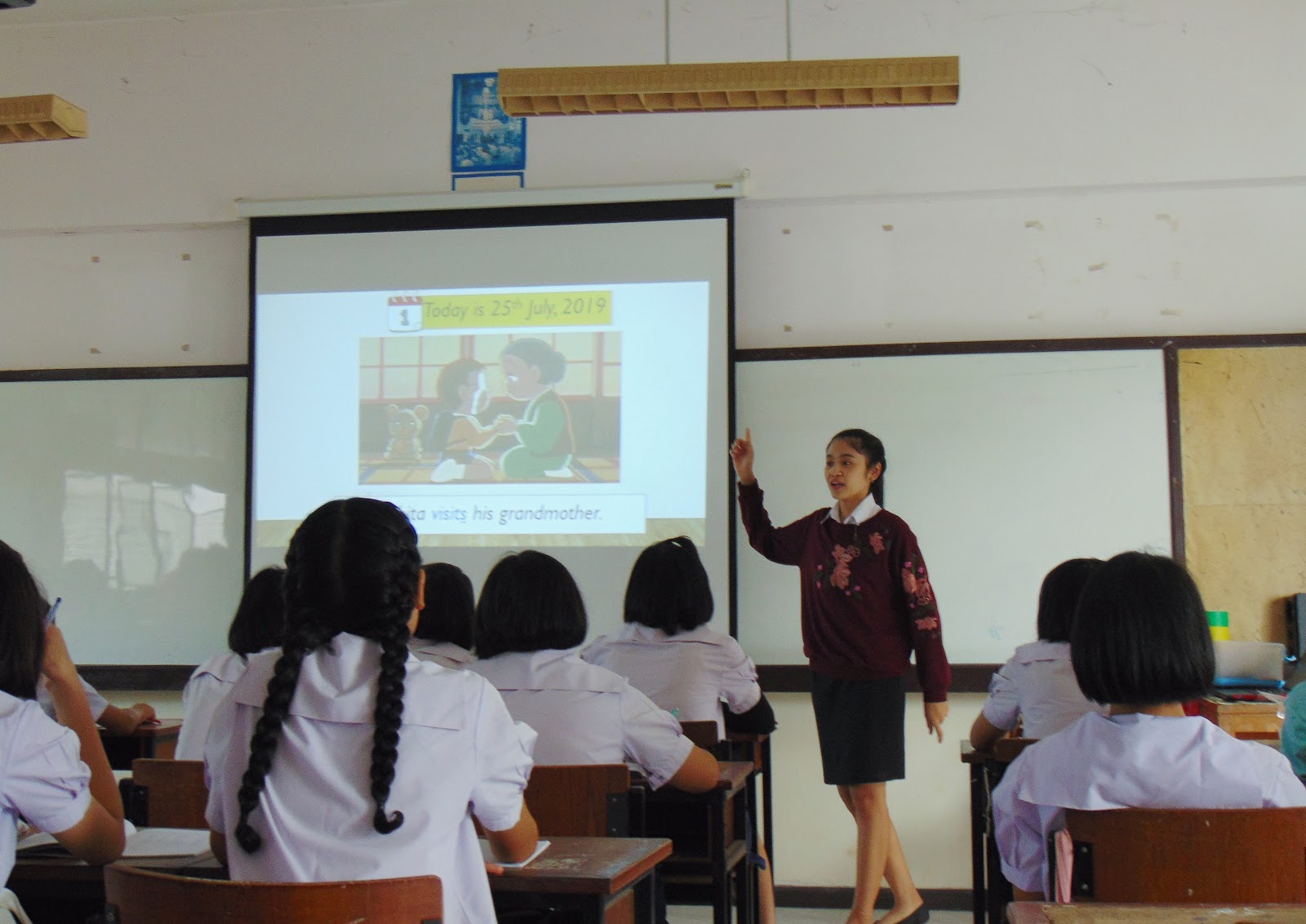
During this time, I was showing and explaining the examples of conversation between two people. The conversations contain simple future tense. In the end, I guided the students to draw out the structure of simple future tense based on the examples that had been shown.
Presentation: providing information
►10 minutes for Focused Practice.
During this time, the students were working in groups to do an exercise that I gave to them. This activity was done in group, aiming the students to be able to discuss and work with peers.
Group Activity
►10 minutes for Communicative Practice.
During this time, the students were working individually. They had to write sentences by considering a word that is given in each number. This activity was done to measure the comprehension of each student.

 1.3 Problem-Solving 
The problems that I faced were pretty much the same problems that I faced everyday in the classroom. See Teaching Practice #1 to see.

 1.4 Classroom Management 
Different from Teaching Practice #1, my second teaching plan required not only group activity but also individual activity. Group activity is aimed to make the students active and able to work in group. Meanwhile, Individual activity is a follow-up activity that is aimed to find out the capability and the comprehension of each student.

Tuesday, August 20th, I started my very first teaching practice after consulting my teaching plans on the previous day. It turned out that my supervisor, Dr. Rachod, decided to observe me on my first day of teaching. I was a bit confused, because I thought observation would only be done on the final demonstration (last teaching practice). However, I agreed. My first teaching plan required a lot of teaching media such as envelopes and words that were printed on paper. I prepared for everything since the previous week, so everything was ready on the day when my teaching practice started. I did my teaching practices on the 3rd week as scheduled, and I taught 3 classes for 4 periods (M3/1, M3/2 and M3/3). I taught M3/1 twice.

 1.1 Procedures of Teaching 
The procedures of teaching, according to Thailand teaching plan, are mainly divided into 3 steps, they are: Presentation, Practice and Production. Below are the details of my first teaching plan.
Presentation
1. Teacher greets the students.
2. Teacher briefly mentions the topic of the lesson.
3. Teacher states the objectives gained by the lesson.
4. Teacher shows the pictures along with their meaning.
5. Teacher guides the students to pronounce the words.

Power Point Slides for Teaching Practice #1
Practice
6. Teacher divides the class into 8 groups.
7. Teacher distributes worksheet to each group.
8. Teacher gives instruction to students to categorize the words given into their appropriate category.
9. Teacher checks the results of each group.
Production
10. Teacher introduces “Guess the Picture” game to train students’ comprehension and creativity about vocabulary.
11. Teacher divides the class into 4 groups.
12. Teacher gives the instructions and rules.
13. Teacher guides the activity.
14. Teacher checks and decides the winner.
15. Teacher reviews and draws conclusion of the lesson.

 1.2 Time Management and Organizing Activities 
One period is equal to 50 minutes of teaching. However, due to the transition time between courses that usually takes around 5 minutes, and another 5 minutes to set up everything, it is save to say that the actual learning and teaching process only last for 40 minutes. I calculated the time management using the 40 minutes estimation time. I managed the time and divided my 40 minutes for 3 activities. The activities were as follows:

►20 minutes for Presentation.
During this time, I was showing and explaining the vocabularies to the students. I asked them to read the words and repeat what I was saying.
Presentation: providing information

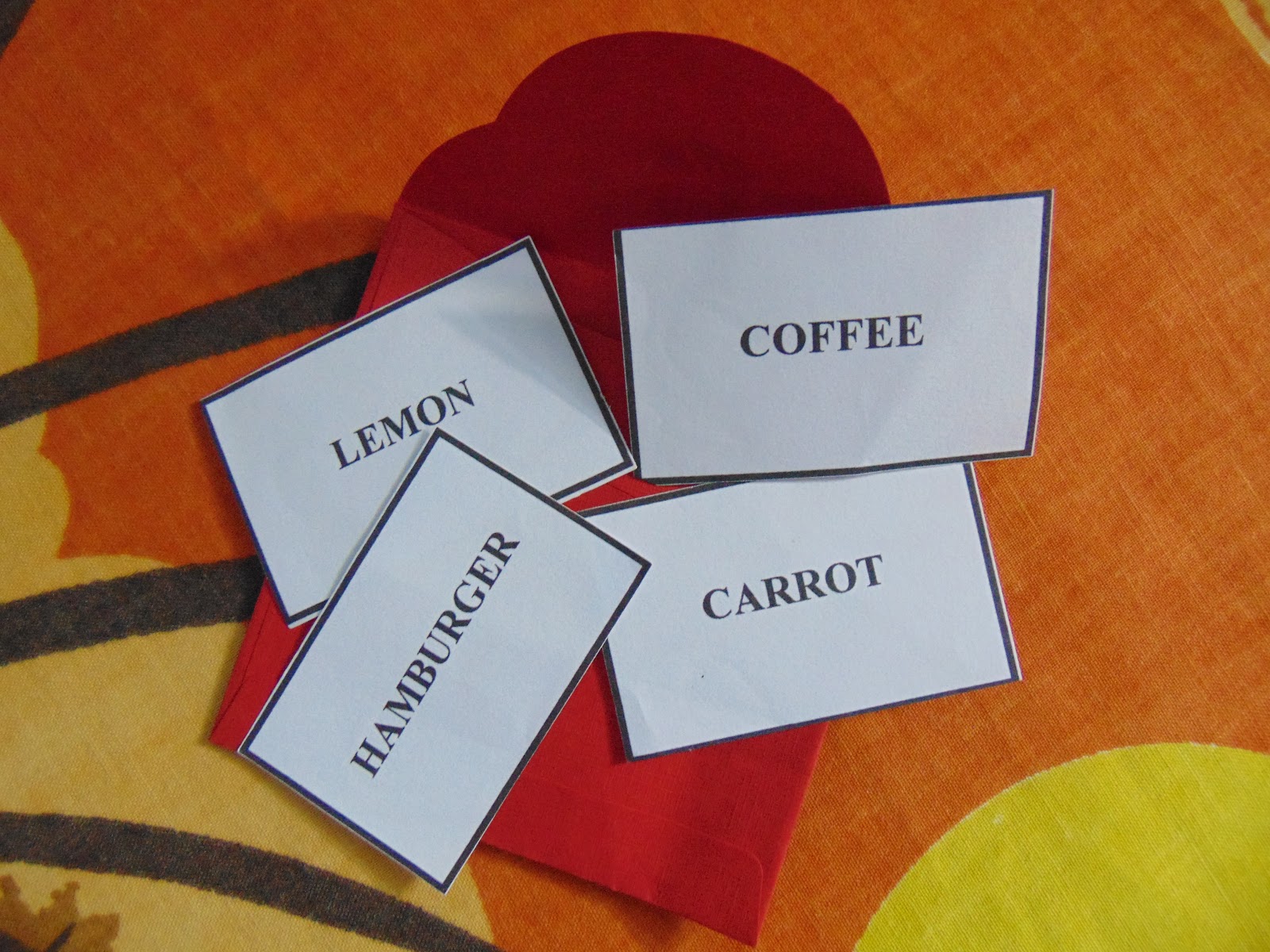
►5 minutes for Practice.During this time, the students were working in groups to arrange and categorize the words that I had distributed to them. The words should be attached on the provided worksheet.
Media for "Words Categorizing" activity
 ►15 minutes for Production.
During this time, the students were working in groups, one of them became the representative of the group. The representative drew a picture based on the word that I gave to the representatives only. The rest of the members should guess the words that were drawn by their representative.
Media for "Guess the Picture" activity
 1.3 Problem-Solving 
The problems that I faced during the teaching practice were various, for instance, the students were: not paying attention, feeling sleepy, and having irrelevant conversation with others. Dealing with these problems was easy but a bit tricky. Wrong reaction given toward the students might worsen the condition of the class and make the classroom less effective. Considering the fact that these students need extra care, I tried to deal with these problems by asking the students to repeat the words that I said. My aims in asking them to do so were: 1. Directing their attention to me and to the learning process, 2. Making them aware that I noticed the problems that they created (sleeping, talking, etc),  3. Making them practice the vocabulary so they could catch up with their classmates.

 1.4 Classroom Management 
The Basic Education Core Curriculum mentions that the learning process in school should be learner-centered. It aims the students to be active and able to work collaboratively with other students. Therefore, I managed the classroom in a way so that the students were able to work with their peers. I designed two group activities that required the students to work together in groups. The first activity was categorizing vocabulary, and it allowed me, as teacher, to measure and evaluate the learning process, and draw conclusion whether the students were able to comprehend the new vocabulary or not. The second activity was guessing pictures that were drawn by a representative of the group. This activity let me know whether the students are able to pronounce the vocabulary correctly or not, and in addition, this activity also encourage the students to be creative because they have to let their friends to guess the word by a picture that they drew.


 1.5 Others 
Teaching a foreign language to students who do not speak the same language as I do was difficult. Our language differences had become my greatest obstacle in teaching and communicating with my students. They do not speak English well, and I myself do not speak Thai at all. However, I was obliged to be more creative and thought of the solution for the problem. Therefore, I would say that language difference was challenging and exciting, and it gave me a lot of lessons and experiences.

Day 14 in Thailand, it was the 16th of August. I had developed at least two teaching plans, and by then I could draw some differences between Indonesia's and Thailand's teaching plan. These differences might be insignificant, but they are worth pointing out. In my personal opinion, I consider Thailand's teaching plan is simpler than Indonesia's. I have gathered some differences which you can see on the table below:


Similar to the process of making my first teaching plan, I developed my second teaching plan. I put one different learning standard (F 1.2 M.3/1) because I had to adjust them with the skills that I wanted the students to develop. Learning standard that starts with code F1.1 is for receptive skills, and learning standard that starts with F1.2 is for productive. Therefore I added F1.2 because I wanted my students to be able to write future tense sentence. Pay attention to the comparison below to see the difference.


And again, the learning standards and indicators are provided within "The Basic Core Curriculum" B.E. 2551 (A.D. 2008) by the Ministry of Education, Thailand.

Below is the full version of my second teaching plan


Thailand has a day set aside to celebrate the Thai language and encourage its use. Thai Language Day aims to raise awareness among Thai citizen of the value and necessity of the national language, and to help preserve its use in Thailand. National Thai Language Day falls on the 29th of July every year, but Suksasongkhro Chiang Mai School celebrated the Thai Language day on 14th of August, since 29th of July is public holiday.

The school celebrated the day by administering competitions involving Thai language. For instance, singing competition, Thai proverb competition, and Thai verse competition. Singing competition was open to all students who wanted to join. Each participant sang the same Thai song. The winner of the singing competition came from grade 9 or mattayom 3. Meanwhile, Thai proverb competition was done in team, each team consisted of three students from the same grade. The participants were from grade 6 or mattayom 1 (team 1), grade 7 or mattayom 2 (team 2) and grade 9 or mattayom 3 (team 3).

Thai Verse Competition

The school freed all students from their classes in order to celebrate the Thai Language Day. The competitions were finished by mid-day, and I spent the rest of the hour at school finishing my teaching plans.

Tuesday, 13th of August.
My presence in Thailand had reached the second week, and as scheduled, that was time to create my teaching plans. Starting off from Ms. Seelakun's teaching plan, I learned to develop my own. Here is how my first teaching plan was created:

 1.1 Curriculum 
Thailand's teaching plan, just like Indonesia's, is based on a core. The teaching plan is developed from learning standards which will then be developed into objectives. The objectives of learning will be gained through the learning process which is called "Procedures"

Steps in making the teaching plan:
1. start with the Identity of the teaching plan
The identity of teaching plan consists of: title, learning unit, subject, teaching plan about (focus), grade, course code, time allotment, teacher's name, and cooperating teacher's name.

2. consult the material with the learning standards and indicators
The learning standards and indicators is provided within "The Basic Core Curriculum" B.E. 2551 (A.D. 2008) by the Ministry of Education, Thailand.


3. determine the Main Concept & Rationale, and Enduring Understanding for the teaching

4. develop the objectives of the learning by consulting with the learning standards

5. determine the students competencies and outcomes that are expected

6. mentioned the language features involved during the learning process

7. state the steps of the teaching, or the procedure

8. list the teaching aids that are going to be used in teaching

9. plan how the evaluation of teaching will be done

10. provide a post teaching form containing learning management results, barriers, suggestion for corrections, and suggestion from cooperating teacher


 1.2 Teaching Plan 
Below is the full version of my teaching plan.


On the previous day, Wednesday the 7th of August, I have observed at least two classes taught by Ms. Seelakun. The first class, mattayom 3/2, was conducted at 8.30 up to 9.20, and the second class, mattayom 3/3, was conducted at 13.40 up to 14.30.


After conducting observation on Ms. Seelakun's classes and gathering some information from her, here are some pedagogical contents that I managed to collect:

 1.1 Teaching Methods 
Ms. Seelakun used student-centered learning method as it had to be used by all teachers, considering that this method is mentioned in the current curriculum provided by the Ministry of Education of Thailand. She provided information to the students and engaged the students to be active during the learning process.

 1.2 Learning Materials and Innovation 
The learning materials that she taught on that day was based on the "New World - Student Book" unit 5 about Past Tense. Then she developed and adjusted the materials by considering her students' competence. She decorated the presentation slide show with cartoon characters, Doraemon, to attract the students' attention, and she provided examples based on real life condition to make the learning process become authentic.
Teaching Plan - Unit 5 Did You Have Good Time?


 1.3 Sources of Learning and Technology Used 
Sources of Learning: Student Book "New World" for grade 9, and pictures from the internet
Technology Used: Power Point Slide Show (Laptop and Projector)
New World - Student Book, for Grade 9 (Mattayom 3)

 1.4 Authentic Assessment 
Ms. Seelakun gave worksheet to students and she observed the students, while they were doing the worksheet, in order to assess each student's ability and comprehension. The worksheets were given after she explained the materials about Past Tense to students.


I woke up at dawn on the 7th day of August. I took my glass and I walked, like a zombie, down to the first floor of CMRU's International House to get myself a glass of hot water. I went back to my room, then I made myself a cup of hot coffee. Coffee has always been the source of my "mana". It never fails lifting up my mood, especially in the morning. After finishing my coffee, I took bath and got myself ready. I rushed to the pick up point of the CMRU's van. The van should drop me off in SSCM School every morning. However, I should be at the pick up point before 7.30, otherwise I would be left behind.

Arrived in SSCM School. It was my second day at school. I went straight to the teachers' room, and proceeded to the hall where everyone gathered and sang the national anthem. After singing, we went back to the teachers' room. I had been assigned to a student teacher whom I would observe during the SeaTeacher project. I had been calling her "Pern" until the fourth day of school when I realized that I should be calling her "Ple", the last syllable of "Apple", her nickname. I had never felt this embarrassed, but I did not think she noticed, so I said nothing. I spent the next periods of classes observing her classes.

Teacher Ple (Ms. Orradee Seelakun) teaching the 9th graders

apple picture: kissclipart.com

4th day in Chiang Mai, Thailand. It was 6th of August 2019. My receiving university's coordinator, Ms. Arry took me to the school where I would be doing the SeaTeacher program. The name of the school is Suksasongkhro Chiang Mai (SSCM) School. It is located about 7 kilometers away from Chiang Mai Rajabhat University (CMRU). It took about 15 minutes to get to the school by university's van.

We arrived in SSCM School and we were welcomed by the teachers. I was directed to a place where everyone was gathered. All students, teachers, and even student teachers were there. My friend and I were asked to introduce ourselves in front of everyone, and so we did. I felt so honored, but I was not prepared.


I spent the rest of the day visiting all areas of the school and here are some information related to the school that I gathered:

 1.1 School Profile 
Suksasongkhro Chiang Mai School is a school for children with difficult backgrounds; either they are financially incapable, from abusive homes or hill tribe and migrant families. The school believes that education is the best way to reduce people’s inequality, they try their best for students to gain best potential in both theoretical and practical knowledge. After graduation, each student is expected to have a viable pathway such as internships or work for their better future.

This school is a boarding school which aims to create its own family environment since so many of the students don’t have solid families. One of the teachers, said, “We live together as a family, even we have different races, cultures, and beliefs, but we still live together happily.”


They bring children from different societies, cultures, beliefs together and teach them how to live with each other, how to accept these differences. Not only that, they also teach children to value local assets like tradition which is a way to maintain the prosperity of culture.

 1.2 Academic Support System 
SSCM School is a boarding school that aims to help children in need and those who have difficulties. The school is completely tuition-free and funded by the government. They provide the students with dormitories, books, food, uniforms and everything that they need.

 1.3 Teaching System 
The teaching in SSCM School is done by teachers and aided by the student teachers. Student teachers are students of education faculty who are undergoing teaching practices in schools during their 5th year of study. SSCM School uses learner-centered / student-centered method of teaching. This method aims the students to be active and confident during the learning process.

 1.4 Materials and Other Learning Sources 
The teachers teach the students based on the current curriculum, and the materials given are based on the books that were provided by the ministry of education or the government. Some teachers also integrate the material from the book with other resources to enrich the students' knowledge.

 1.5 Measurement and Evaluation System 
The school measures and evaluates both the students and the learning outcome through tests and observation. There are four tests per academic year, or two tests for each semester administered by the school, apart from the daily test and worksheet. The tests are conducted on the middle of the semester (mid-test), and by the end of the semester (final-test).

 1.6  Curriculum 
The school's current education system stems from the reforms set by the 1999 National Education Act which implemented new organisational structures, promoted the decentralization of administration and called for innovative learner-centered teaching practices. The Thai education system provides 9 years of compulsory education, with 12 years of free basic education guaranteed by the Constitution. SSCM School itself provides 12 levels of school starting from Primary Education or "Prathom" (Grade 1-6) up to Lower and Upper Secondary Education or "Mattayom" (Grade 7-12).

 1.7 Teaching Plan (of English) 
SSCM School teachers develop their teaching plan by taking the learning standard and indicators from The Basic Education Core Curriculum B.E. 2551 (A.D. 2008) provided by The Ministry of Education. Each teaching plan will adapt at least one of the learning standards. Then, it will be developed into objectives, and these objectives will be gained through the learning process which is broken down into several steps that is also called as "Procedure". After the learning process is done. The teacher will evaluate the problems that happened during the learning. Below is the example!

Ms. Orradee Seelakun's teaching plan